TL;DR
Bleeding gums are a clear sign of inflammation, usually caused by plaque buildup or early gingivitis. Unlike advanced periodontitis, early gum disease is fully reversible with professional care. Dr. Ibrahim Sayeed at Walden Dental NY provides conservative, non-judgmental treatments, ranging from standard cleanings to scaling and root planing, to stop the infection, protect your bone health, and ensure your smile stays intact.
If your gums bleed when you brush or floss, that’s not normal, and it’s not because you’re brushing too hard. The good news is that when it’s caught early, gum disease is very treatable and, in many cases, completely reversible.
I see many patients here in Walden who come in for a dental cleaning and mention, almost in passing, that they see a little “pink in the sink.” There is a common misconception that bleeding is just a sign of a thorough cleaning or a result of using a medium-bristle brush. As the top-rated dentist, I want to clear that up: bleeding is your body’s way of sounding an alarm. It is a sign of inflammation, and ignoring it is like ignoring a check-engine light in your car.
Why Do Gums Bleed When Brushing?
Understanding why gums bleed when brushing is the first step toward fixing the problem. While it can be jarring to see blood, knowing the “why” helps us create a plan to stop it.
- Plaque and Tartar Buildup: This is the most common culprit. Plaque is a sticky film of bacteria. If it isn’t removed by brushing and flossing, it hardens into tartar (calculus), which irritates the gum tissue.
- Early Gingivitis: This is the earliest stage of gum disease. The bacteria in plaque produce toxins that cause the gums to become red, swollen, and prone to bleeding.
- Vitamin Deficiencies: Though less common in Orange County today, a lack of Vitamin C can weaken the connective tissues in your gums.
- Blood Thinners and Medications: Certain heart medications, including aspirin, can increase your risk of gum bleeding during your oral hygiene routine.
- Hormonal Changes: We often see “pregnancy gingivitis” where hormonal shifts make gum tissue extra sensitive to bacteria.
Gingivitis vs. Periodontitis: The Critical Difference
In my practice, I emphasize a conservative philosophy. The goal is always to catch issues while they are still in the “Gingivitis” stage.
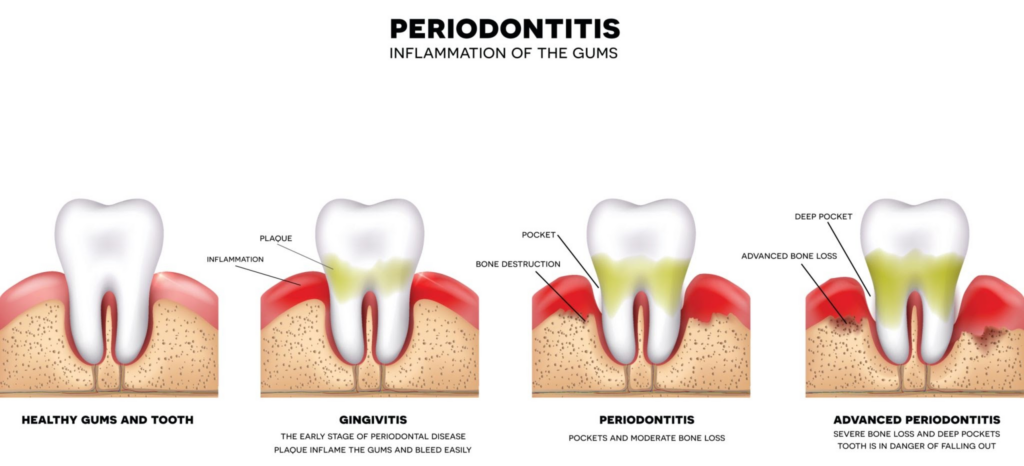
Gingivitis is the only stage of gum disease that is fully reversible. At this point, the inflammation is limited to the soft tissue. The bone holding your teeth in place is still healthy. With professional cleaning and improved home care, we can return your gums to a healthy, pink, non-bleeding state.
Periodontitis, however, is the advanced stage where the infection has spread below the gum line to the bone. Once bone is lost, we cannot grow it back naturally. This stage is not “reversible,” but it is manageable. If you wait until your teeth feel loose or your gums have significantly recessed, the treatment becomes more complex. This is why addressing bleeding gums brushing in Walden, NY, is so vital at the first sign of trouble.
How We Assess Your Gum Health
When you visit Walden Dental NY, we don’t just look at your teeth; we look at the foundation holding them. To provide the best early gum disease treatment in Orange County, I use two primary diagnostic tools:
- Pocket Depth Measurements: We use a small, painless instrument to measure the space between your tooth and gum. Healthy pockets are 1 to 3 millimeters. Anything deeper suggests that the gum has started to detach due to infection.
- High-Resolution Digital X-rays: These allow me to see your bone levels instantly on our chairside monitor. If the bone is flat and high, you’re in good shape. If I see ‘shadows’ or dips in the bone, it tells me the infection has progressed past the surface and needs more targeted care.
The Treatment Path: From Cleaning to Healing
My approach is always to start with the most conservative treatment necessary to get results.
- Standard Prophylaxis (Cleaning): If you have mild gingivitis, a thorough cleaning by our hygienist to remove plaque and tartar above the gum line is often enough to stop the bleeding.
- Scaling and Root Planing (Deep Cleaning): If the infection has gone deeper, we perform a deep cleaning. We prioritize your comfort by using localized numbing or gentle techniques, ensuring the process is pressure-free and easy.
- Ongoing Maintenance: After a deep cleaning, we see you more frequently for “periodontal maintenance” to ensure the infection doesn’t return.
Why Professional Cleaning is Essential
I often tell my patients: you can be the world’s best “brusher,” but you still can’t remove tartar once it has hardened. Tartar is like barnacles on a boat; it requires professional instruments to be safely removed.
Our gum disease prevention services are designed to be a “reset button” for your oral health. We remove the irritants so your immune system can finally stop the inflammatory response, which means no more bleeding, no more tenderness, and a much lower risk of tooth loss.
Call 845-713-4822 or book an appointment online at Walden Dental NY. Dr. Sayeed’s first priority is making you feel comfortable.
Walden Dental NY
57 Main St, Walden, NY 12586, United States (Find Us on Google)
Phone: 845-713-4822
Email: [email protected]
FAQ: Gum Disease & Bleeding Gums
Is it normal for gums to bleed a little bit during flossing?
No. Healthy gums do not bleed when flossing. If they do, it usually means there is bacteria-laden plaque sitting between the teeth that needs to be removed by a professional cleaning.
Can I fix bleeding gums at home?
You can improve them with better brushing and flossing, but you cannot fix them if tartar has already formed. Professional intervention is required to remove the hardened deposits that keep the gums in a state of inflammation.
Does insurance cover gum disease treatment?
Most plans, including local PPO and Medicaid/Fidelis plans, cover preventive cleanings and often provide coverage for deep cleanings (scaling and root planing) if clinical need is demonstrated by pocket measurements and X-rays.
How long does it take for gums to stop bleeding after a cleaning?
Most patients see a significant improvement within 7 to 14 days following a professional cleaning, provided they follow the recommended home care routine.
 Dr. Ibrahim Sayeed is a licensed Dentist in the State of New York and the lead practitioner at Walden Dental NY. A graduate of the University of the Pacific School of Dentistry with post-graduate training at Brookdale Hospital Medical Center, he has extensive experience in restorative, cosmetic, and preventive dental care.