
Summary
Years of wearing dentures lead to natural jawbone shrinkage because there are no tooth roots to stimulate the bone. A dental bone graft uses sterile mineral granules to create a scaffold, prompting your body to rebuild its own healthy bone over 3 to 6 months. For former smokers, quitting radically improves the success of this healing process. Dr. Sayeed uses precise digital diagnostics at Walden Dental NY to provide an honest look at your candidacy and safely prepare your mouth for stable, permanent implants.
If you’ve worn dentures for years and are now exploring implants, you’ve probably been told you might need a bone graft first. That can feel like another barrier. Here’s what it actually means and what the process looks like.
Lately, our clinic has received several inquiries from long-term denture wearers throughout Orange County who want to transition to a stable, permanent smile. One patient recently shared that after wearing dentures for over a decade, and successfully achieving the major milestone of quitting smoking, they were eager to get implants but terrified that their bone had deteriorated too much.
Having bone loss does not automatically disqualify you from a permanent smile. It just means we need to prepare the foundation first.
Why Long-Term Denture Wearers Lose Jawbone
To understand why you might need a bone graft before a dental implant in Walden, NY, it helps to understand how your jaw works.
Your jawbone relies on your natural tooth roots to stay healthy. Every time you chew, those roots send tiny vibrations into the bone, signaling your body to keep sending nutrients to keep that bone strong and dense. When you lose your teeth, that stimulation stops. Traditional dentures simply sit on top of the gums; they do not stimulate the bone beneath.
Over a decade or more of wearing dentures, the jawbone naturally resorbs (shrinks away). This is why your dentures become loose over time and require frequent adjustments or relines—there is physically less bone to hold them in place.
What Exactly is a Dental Bone Graft?
A bone graft sounds intimidating, but it is a routine, predictable preparatory procedure. Think of it as patching a wall before hanging a heavy shelf; we are adding volume and density to ensure the implant post has a secure anchor.
During the procedure, we place a small amount of bone grafting material into the area where the bone has thinned out. This material acts as a biological scaffold. Your body recognizes it and uses it to build new, living bone over the course of a few months.
What Materials Do We Use?
Modern dental medicine allows us to use highly processed, sterile mineral granules from human or animal donors, as well as synthetic materials. At Walden Dental NY, I primarily utilize specialized, laboratory-processed donor or synthetic bone. This is highly effective, prevents the need for a second surgical site on your own body, and has an exceptional safety and success record.
The Treatment Timeline: Step by Step
Transitioning from decades of dentures to implants requires patience, as we must respect your body’s natural healing speeds.
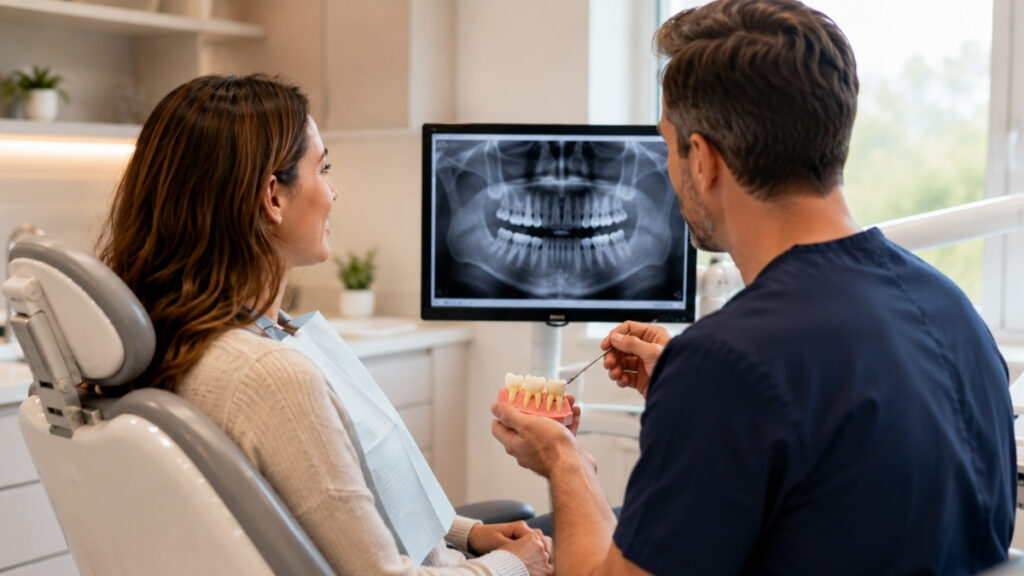
- Detailed Radiographic Assessment: I will never recommend a bone graft based on a guess. We utilize detailed digital X-rays and a meticulous clinical exam to evaluate your current bone density and jaw ridge height. If you have enough native bone structure remaining, we can skip the graft entirely.
- The Grafting Procedure: The graft is placed comfortably in our chair under profound local anesthesia. Most patients report that it feels no different than a standard filling appointment.
- The Healing Window (3–6 Months): Your body undergoes osseointegration and builds new bone tissue. You will continue to wear your modified dentures during this time so you are never left without teeth.
- Implant Placement: Once the new bone is strong and stable, we place your titanium dental implants.
- Final Restoration: After the implants fuse to the new bone, we secure your permanent, non-slipping teeth.
A Note on Quitting Smoking: Your Biggest Advantage
If you are a former smoker who has recently quit, I want to personally congratulate you. Quitting smoking is one of the single best things you could have done for your bone loss implant candidacy in NY.
Nicotine drastically constricts blood vessels and cuts off the oxygen supply your gums and jawbone need to heal. Smoking heavily increases the failure rate of both bone grafts and dental implants. By quitting, you have fundamentally restored your body’s blood circulation. Your capacity to successfully heal a bone graft and lock an implant permanently into place is now significantly higher.
Honest Facts About Cost and Insurance
Bone grafting is an added step, which means it adds to the financial timeline of your restoration. A localized bone graft typically costs between $400 and $1,200 per site, depending on the extent of the bone loss.
Will Insurance Help?
Most traditional dental insurance plans consider bone grafting to be an advanced or cosmetic-adjacent procedure, meaning full coverage is rare. However, if the graft is deemed medically necessary to restore basic chewing function after severe structural collapse, some plans do offer partial coverage. Our administrative team will review your specific PPO or managed-care benefits to see what can be applied, and we offer low-interest monthly financing to ensure the cost is manageable.
Conclusion: Don’t Let Bone Loss Stop You
If you have stayed away from the dentist because you assume your jawbone is “gone,” please let us give you an honest look. Modern technology allows us to rebuild what time and dentures have taken away. We specialize in providing a warm, non-judgmental environment where we focus entirely on your path forward.
Call 845-713-4822 or book an online appointment. Dr. Sayeed’s first priority is making you feel comfortable.
Address:
Walden Dental NY
57 Main St, Walden, NY 12586, United States. (Find Us on Google)
Phone: 845-713-4822
Email: [email protected]
Frequently Asked Questions
Can you get dental implants after years of wearing dentures?
Yes. While long-term denture wear causes jawbone loss, bone grafting techniques can rebuild the ridge to the proper height and width. This creates a secure, dense foundation capable of supporting permanent dental implants even if you have been missing teeth for decades.
How painful is a dental bone graft procedure?
The procedure itself is entirely painless because it is performed under strong local anesthesia. Afterward, you may experience mild swelling and a dull ache for 2 to 4 days, which is highly manageable with over-the-counter anti-inflammatories like ibuprofen.
Where does the bone come from for a dental implant graft?
Most modern dental bone grafts use highly processed, sterile donor bone (allograft) or mineral-based synthetic materials (alloplast). These materials are thoroughly tested, completely safe, and eliminate the need to harvest bone from your own chin or hip.
How long do you have to wait for an implant after a bone graft?
On average, a bone graft takes 3 to 6 months to completely mature and integrate into your natural jawbone. Once a follow-up exam and digital radiographs confirm the new bone is strong and dense enough, the titanium implant post can be safely placed.
 Dr. Ibrahim Sayeed is a licensed Dentist in the State of New York and the lead practitioner at Walden Dental NY. A graduate of the University of the Pacific School of Dentistry with post-graduate training at Brookdale Hospital Medical Center, he has extensive experience in restorative, cosmetic, and preventive dental care.