
We’re pleased to share that our 3D dental imaging is now IAC accredited. If you’ve had a 3D scan with us for an implant, a root canal or a wisdom tooth, or you’ll need one in future, here’s what that means for you.
What Is CBCT?
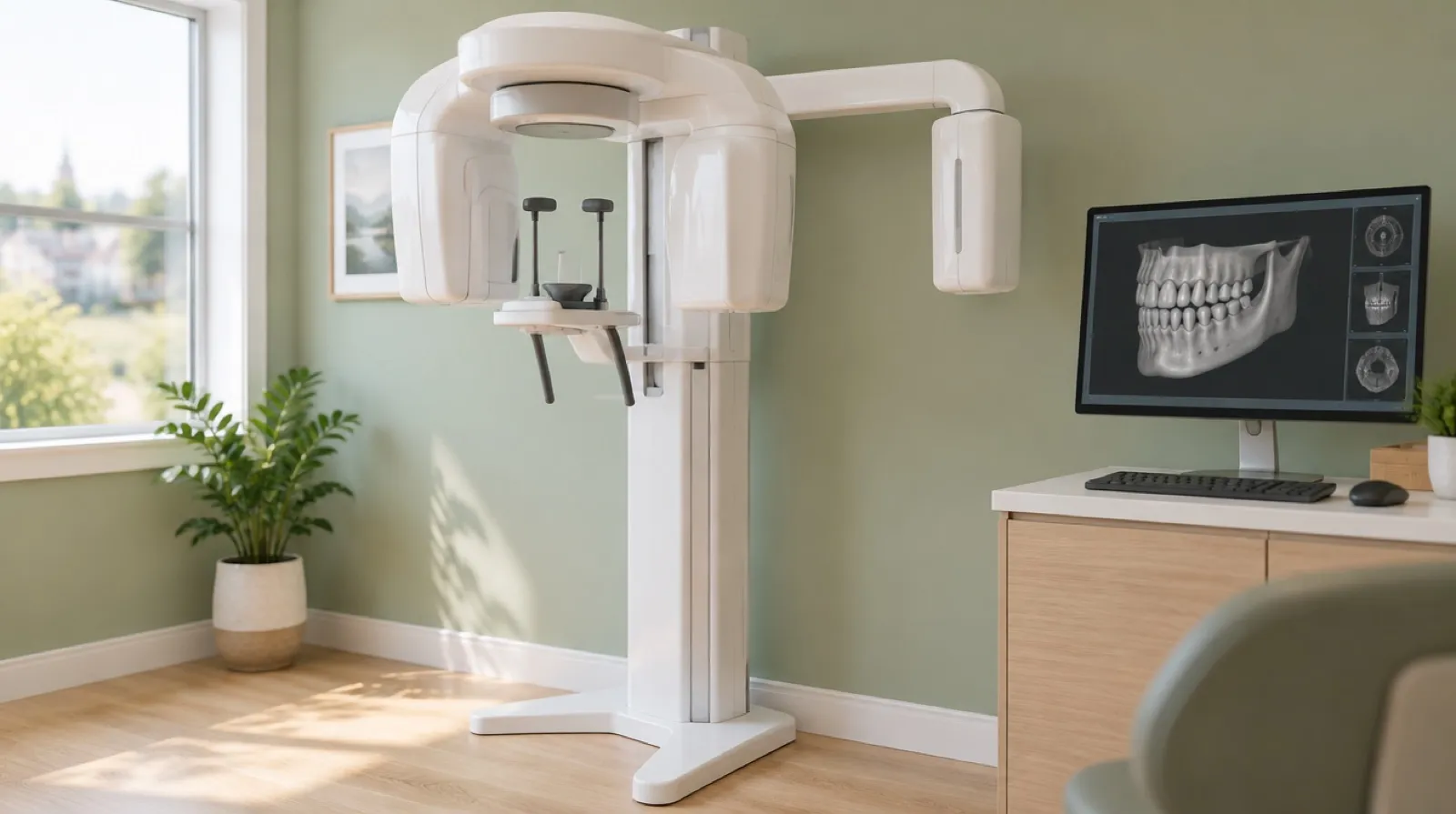
Cone beam computed tomography, or CBCT, is a 3D X-ray of your teeth and jaw. A regular dental X-ray is a flat picture. A CBCT scan shows bone height and width, nerve canals, sinuses and the shape of each root in three dimensions. The scan takes less than a minute, and you sit or stand while the arm turns around your head.
We use it when a flat X-ray can’t show enough, for example to:
- Plan dental implants around the bone and nerves
- Find extra canals or hidden infection before a root canal
- See where a wisdom tooth sits in relation to the nerve
- Check bone after an extraction or a graft
What IAC Accreditation Means
The Intersocietal Accreditation Commission is a nonprofit that accredits medical and dental imaging. To earn Dental CT accreditation, a practice submits its scanning protocols, sample scans and safety records for review against IAC’s published standards. The review covers:
- Image quality: scans that are clear enough to diagnose from
- Radiation safety: settings that use the lowest dose that still gives a useful image
- Equipment checks: regular testing and quality control of the scanner
- Training: the qualifications of the dentist and staff who take and read the scans
In short, it’s independent proof that your scan is taken safely and read properly.
Why New York Now Requires It
On July 22, 2026, the New York State Department of Health finalized new rules for dental offices that use CBCT. Outside New York City, every practice with a CBCT scanner must now be accredited by an approved body. The state recognizes two: IAC and RadSite. Practices that already had a scanner have until January 2028 to finish. Walden Dental NY has already completed it.
What It Means at Your Next Visit
Nothing changes in how a scan feels. You’ll still only have one when it adds something a flat X-ray can’t, and we’ll explain why before we take it. The difference is that the way we take and read it has been checked independently.
We only take a 3D scan when it will change the plan, and when we do, patients deserve to know it’s been done safely and read properly. Accreditation is how we show that.
— Dr. Ibrahim Sayeed, DDS
Questions about a scan, or about whether you need one? Read more about Dr. Sayeed, make an appointment or call (845) 713-4822.
Frequently Asked Questions About CBCT Scans
Is a CBCT scan safe?
A dental CBCT scan uses more radiation than a single flat dental X-ray but usually much less than a medical CT scan. Accreditation checks that the scanner is set to the lowest dose that still gives a useful image, and we only take one when it will change your treatment.
Will I need a CBCT scan?
Most checkups and fillings don’t need one. A 3D scan is most often used to plan dental implants, complex root canals and wisdom tooth removal, or to look at bone after an extraction or graft.
What does IAC accreditation mean?
It means the Intersocietal Accreditation Commission, an independent nonprofit, has reviewed the practice’s 3D imaging equipment, image quality, radiation safety and staff training and found that they meet its published standards.
Do all New York dentists with CBCT need accreditation?
Outside New York City, yes. New York State rules finalized in July 2026 require dental practices that use CBCT to be accredited by IAC or RadSite. Practices that already had a scanner have until January 2028.